
MDF Production Line
While the production method has a few differences at different factories, but the principle and most of the stages are the same. The general steps used to produce MDF include mechanical pulping of wood chips to fibers (refining), drying, blending fibers with resin and sometimes wax, forming the resinated material into a mat, and hot pressing.
As a general concept for MDF production, and in order to obtain the necessary mechanical strength in MDF boards, the primary material should be in the form of needle-shaped fibers. In other words, the length to long diameter ratio is about 13 to 1 in the range of more fibers. The wood consists of three main materials: cellulose, hemicellulose and lignin, and its structure is fibrous cells (because of water flow in trees) which is bonded together by lignin, and thus the lignin play as an intercellular cement role. As a result, the lignin must first be softened, and then wood chips or other lignocellulosic materials must be put between rotating grinding disc and a stationary disc each with radial grooves that provides the grinding surface, and the fibers are separated from each other. The longer fiber, the better mechanical resistance due to the interlocking of the fibers. If you squeeze some sand into the compartment, you will see that after the pressure is removed, it will be restored to its original state, but if you do the same with some needle, you will see that after removing the pressure, a coherent structure is formed. This is what MDF is about. The rest of the mechanical strength required will be achieved through the use of adhesive binding between the fibers or the same.
As a general concept for MDF production, and in order to obtain the necessary mechanical strength in MDF boards, the primary material should be in the form of needle-shaped fibers. In other words, the length to long diameter ratio is about 13 to 1 in the range of more fibers. The wood consists of three main materials: cellulose, hemicellulose and lignin, and its structure is fibrous cells (because of water flow in trees) which is bonded together by lignin, and thus the lignin play as an intercellular cement role. As a result, the lignin must first be softened, and then wood chips or other lignocellulosic materials must be put between rotating grinding disc and a stationary disc each with radial grooves that provides the grinding surface, and the fibers are separated from each other. The longer fiber, the better mechanical resistance due to the interlocking of the fibers. If you squeeze some sand into the compartment, you will see that after the pressure is removed, it will be restored to its original state, but if you do the same with some needle, you will see that after removing the pressure, a coherent structure is formed. This is what MDF is about. The rest of the mechanical strength required will be achieved through the use of adhesive binding between the fibers or the same.
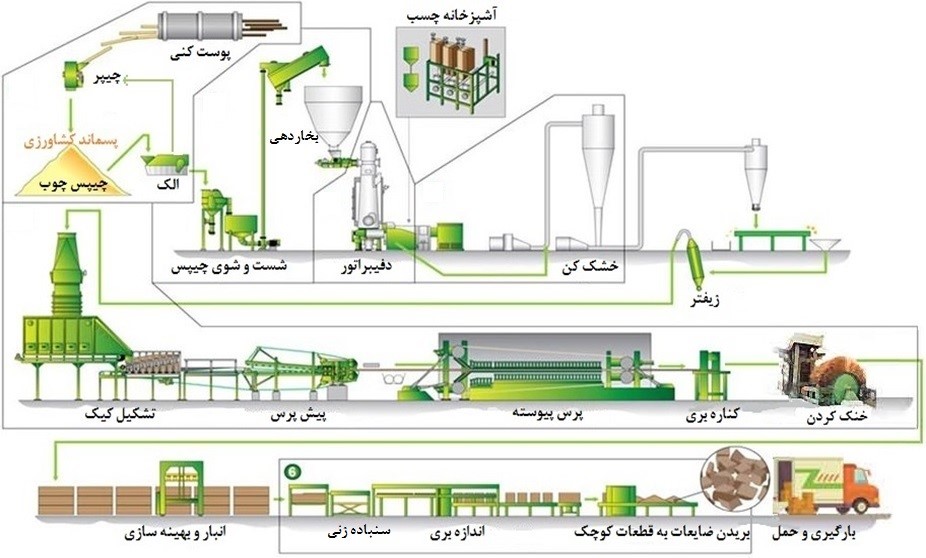

Debarking
The logs goes to the debarking drum, where the bark is separated from the logs. At this stage the wood is transported from the wood yard to the feed chute of the debarking drum by hydraulic crane. From the drum wood logs are transported first by belt conveyor, then by roller conveyor to the wood chipper. Bark is separated from the logs on the roller conveyor. Then it is fed to the energy plant for combustion.

Chipping
Chipping of round wood logs and other shapes, into chips 25х15х10 mm. Chips are transported to chip silos. Chips are transported on the roller conveyor from the silos and are divided in three fractions: large fraction (bigger than 25x25x10 mm) goes into production; conditioned fraction is also used for production; fine fraction (smaller than 25x25x10 mm) is burnt.

Washing
Next, chips are washed to eliminate dust and other unwanted materials and also be same in moisture content.

Steaming
Chips are subjected to steam under pressure and lignin is softened.

Pulping
After removal of excess moisture chips are fed to refiner for fiber production. The defibrator consists of two counter wise rotating plates each with radial grooves that get smaller as they get closer to the circumference. The plug is fed into the center and gets broken down as the centrifugal forces push it toward the outside of the plates where the groves are finer. The feeding devices at the entrance and exit to the defibrillator maintain suitably high pressure and temperature

Fiber moisture reduction
Relatively wet fibers after entering the refiner for initial drying and entering the adhesive region are introduced into a primary pre-dryer.

Blowline
Fibers enter the blowline. The blowline is initially only 40 mm in diameter with the fibers passing through at high velocity. Wax, used to improve the moisture resistance of the finished board, and resin are added in the blowline while the fibers are still wet, as dry fibers would form bundles, due to hydro bonding, and material consistency would be lost. The blowline now expands to 1500 mm in diameter and fibers are dried by heating coils warming the blowline to about 288 °C. The fiber/air ratio is about 1 kg per 31 m3 with air speed of 2.54 m/sec though the air is still humid and the resin does not yet cure. The agitation of fibers in the blowline helps disperse resin consistently. Exit temperature is about 82 °C. The fibers may be stored in bins for an unspecified length of time but the board making process is usually continous from here on. The Moisture Content of the fibers is 12%, and thus this is considered a dry process.

Fiber Drying
Fibers with glue are dried in the drier to 10% of moisture content. The drier is heated by flue gases of the energy plant. Then fibers are transported through pneumatic separator to the forming bunker.

Mat forming and pressing
From the bunker, fibers are fed on to the mat former. The mat is formed depending on the finished board thickness. The mat goes through pre-press, then into hot press, temperature 280 °C. After the press, continuous board is cut. Then boards are cooled and stacked. Stack height is 4 m.

Stack storing
Three days are required for the final glue curing of MDF board.

Sanding
After press step, boards have rough surface and are not ready for lamination. To avoid this they are sanded, cut to size (desirable final sizes) and stacked. Stack height is 800 mm.

Packing
Finished board stacks are strapped with packing tape for transportation.

